
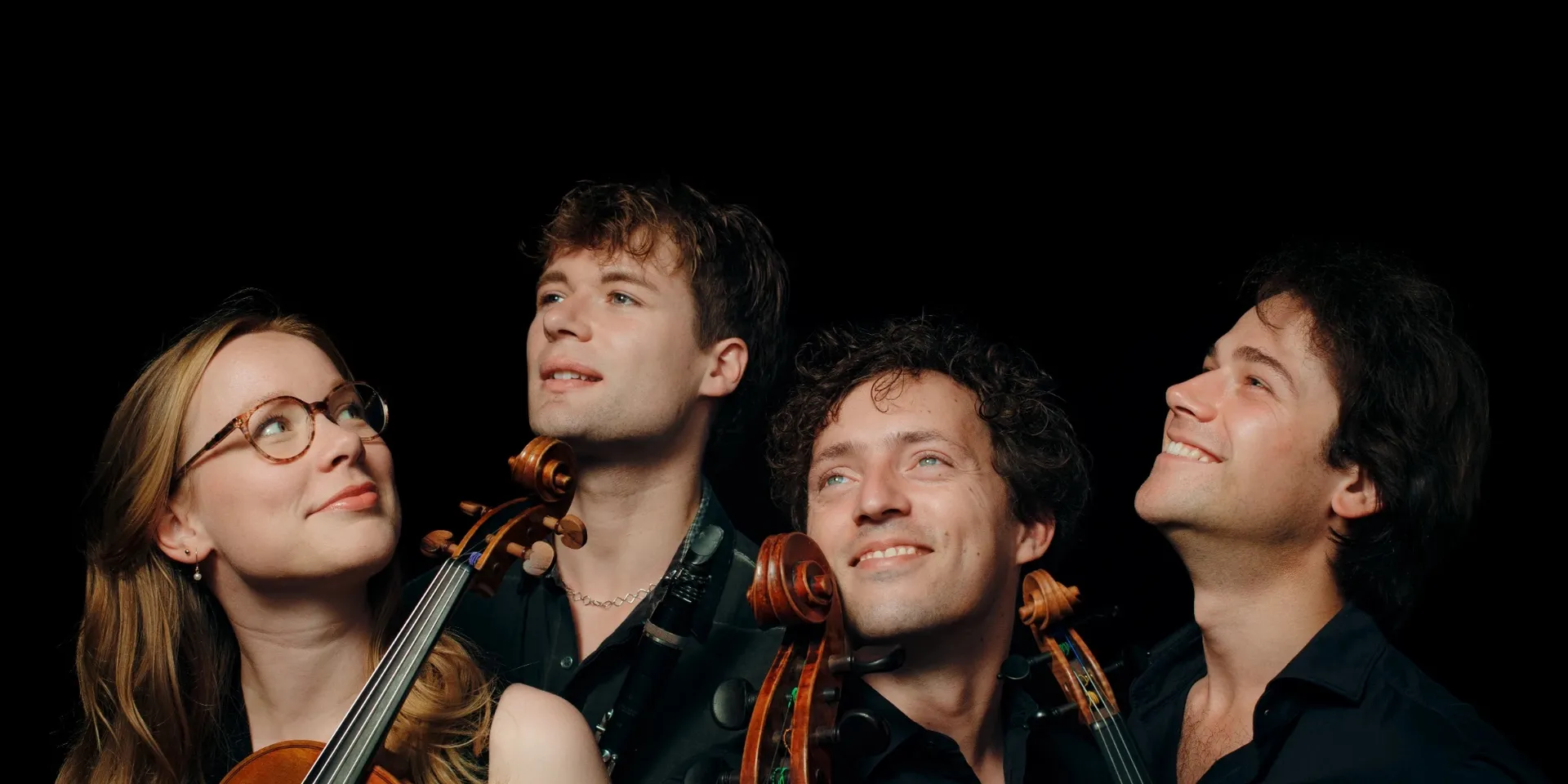
For Den Haag Centraal, Frans van Hilten spoke with Dimitri van der Werf about the Heaven on Earth festival, from Wednesday 25 to Sunday 29 November in the Paleiskerk.
‘Heaven on Earth’ is the theme of Classical NOW!’s upcoming festival, with pieces about the sun, the moon and angels, and a special emphasis on works for two pianos.
By Frans van Hilten
“Throughout the centuries, the divine, angels and magic have played an important role in music. Above all, of course, in the Middle Ages and the Renaissance. In later centuries heaven seems to have been pushed into the background in music, but appearances are deceptive. Later composers, too, felt closely connected with angels, fallen or otherwise, with planets, a divine order and so on.” The speaker is Dimitri van der Werf, artistic director of Classical NOW! At the Heaven on Earth festival, ‘heavenly’ music can be heard in five concerts. “The aim was to programme a beautiful festival around a compelling theme. Five coherent programmes that also form a whole together.”
Van der Werf started from the idea of a festival for two pianos. “At our Ravel festival we played various pieces for two pianos. That was very festive; it sounds enormously orchestral. Then I started thinking: what else is there for two pianos? You arrive, for example, at Olivier Messiaen’s Visions de l’Amen, which is about the creation, angels and the Day of Judgement. But also at Gustav Holst’s The Planets, which looks at the planets of our solar system from an astrological angle.”
There is also Louis Andriessen’s De Staat (The Republic). “Plato saw the state as a reflection of the world of ideas, as an abstract universal order. He considered music dangerous, because it could throw the state off balance. Andriessen’s comment on that was: ‘If only that were true!’ We also have parts of Béla Bartók’s Mikrokosmos and George Crumb’s Makrokosmos. For Bartók’s Sonata for two pianos and percussion we fill the stage with instruments. Bartók was enormously inspired by the night, the stars and the moon.”
Esotericism
Van der Werf saw the two concert grands as a beautiful metaphor (in Dutch, a grand piano is a ‘vleugel’: a wing). “Two wings to rise above the earthly,” he says enthusiastically. “And I also had the idea: why don’t we broaden the programme a little? Five evenings in a row of nothing but two pianos – you really have to be in the mood for that. Then I had the idea of choosing heaven itself as the theme. You can approach that in so many different ways, such as through Holst’s astrology. He was interested in theosophy – throughout the centuries, esoteric currents have always existed as parallel ways of thinking, in art as well. Museums devote a lot of attention to that, concert halls and festivals hardly any. A missed opportunity. It makes composers think ‘outside the box’, and that simply produces magnificent, innovative music.”
As an example, Van der Werf mentions Arnold Schoenberg’s Pierrot Lunaire of 1912. “Not only Stravinsky, but also Debussy, Ravel and even Puccini were influenced by it. And if you hear it now, it still knocks you off your chair. We open that concert with the sunrise in a string quartet by Haydn, the sun through a stained-glass window by Bacewicz and a miniature opera at sunset by Respighi, and then we end the evening with Schoenberg’s hallucinatory visions in sound.”
Top talents
Students of the Davidsbündler Music Academy on the Laan van Meerdervoort play Richard Strauss’s Metamorphosen and Schoenberg’s Verklärte Nacht. “The academy was founded by the pianist Anna Fedorova,” says Van der Werf. “These top talents went through a training week there under the guidance of violinist Daniel Rowland and cellist Maja Bogdanović. They are the kind of musicians we love to work with: musicians who also think outside the box and are not afraid to colour the music with their own personality and imagination. Like a co-pilot alongside the composer.”
Sometimes they are young talents, sometimes artists with decades of experience. “Take the pianist Ellen Corver,” says Van der Werf. “She is a principal piano teacher at the Royal Conservatoire here and a truly wonderful musician. And Gerard Bouwhuis was a good friend of Louis Andriessen; he is the obvious person to play De Staat.”
Incidentally, the festival has no spiritual talks or side programme. “I want to let the music speak for itself,” says Van der Werf. “In the programme booklet you can read about the ideas from which the music sprang, but above all I want to celebrate the beauty of the music and its boundless imagination.”
All concerts take place in the Paleiskerk. “That remains a magnificent concert venue,” the artistic director feels. “You sit close by the musicians and the acoustics are fantastic. The force of two grand pianos in fortissimo gets all the room it needs, yet a single violinist playing in a whisper can be heard clearly everywhere too. And the church lies in the heart of the city centre, yet it still feels a little like a village church.”
Classical NOW!, Heaven on Earth festival, Wednesday 25 to Sunday 29 November, Paleiskerk.
This interview by Frans van Hilten appeared in Den Haag Centraal on Thursday 19 November 2026 (page 16) and is reproduced with the newspaper’s permission; translated from the Dutch by Classical NOW!